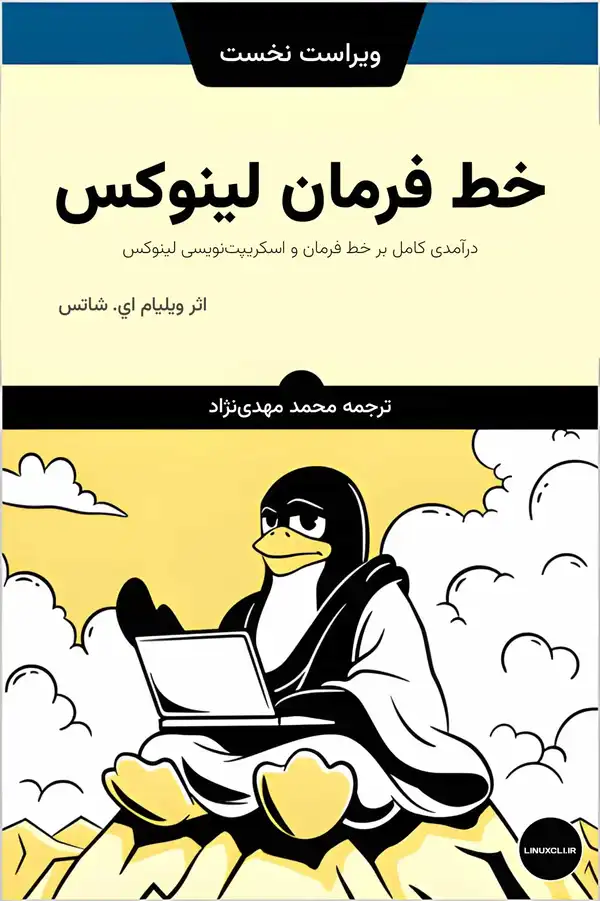
Comprehensive Guide to "The Linux Command Line" – The Ultimate Linux CLI Reference
"The Linux Command Line" by William Shotts, translated into Persian by Mohammad Mehdinejad, is one of the most authoritative and comprehensive resources for learning the Linux command line. With a clear, step-by-step structure, this book guides you from foundational concepts such as navigating the command line environment, managing files and directories, process and job control, to more advanced topics including Bash scripting, user and permission management, system configuration and optimization, package management and software installation, Linux networking concepts, system maintenance and support, regular expressions and text processing, archiving and backup, and even compiling software from source.
📚 Key Topics Covered in This Comprehensive Book:
- Getting Started with the Command Line
- File and Directory Management
- Process and Job Control
- Bash Scripting Essentials
- User and Permission Management
- System Configuration and Optimization
- Package Management and Software Installation
- Linux Networking Fundamentals
- System Maintenance and Support
- Regular Expressions and Text Processing
- Archiving and Backup Strategies
- Compiling Software from Source
Why Choose This Book?
A compelling set of reasons to start learning the Linux command line with this exceptional resource
From Zero to Hero
Assuming no prior knowledge, this book takes you step-by-step from the most basic concepts to advanced Linux command line techniques.
Practical, Real-World Examples
Every chapter includes practical exercises and real-world scenarios that help you understand concepts in action and apply them immediately.
Complete Bash Scripting Coverage
The fourth section of the book is exclusively dedicated to Bash scripting, covering task automation, loops, conditionals, functions, and advanced shell programming.
Perfect for Beginners and Professionals
The step-by-step structure and depth of content make this book ideal both for newcomers and for IT professionals looking to sharpen their Linux skills.
Each chapter combines theoretical instruction with practical exercises, designed to prepare you for real-world challenges in managing and developing Linux systems. This translation has received official permission from the author and is released under the CC BY-NC-ND 3.0 license, serving as a free and valuable resource for students, system administrators, developers, and all open source enthusiasts worldwide.
If you are looking for a complete and practical course in Linux command line, terminal commands, Bash scripting, and professional Linux system administration, this book is your best companion to elevate your skills from beginner to expert and become a Linux power user.
Licensing and Legal Framework
This work is the Persian translation of the authoritative reference "The Linux Command Line" by William Shotts, produced with explicit written permission from the author and in full compliance with the Creative Commons Attribution–NonCommercial–NoDerivatives 3.0 (CC BY-NC-ND 3.0) license. Distribution and use of this translation are subject to the terms of this license: commercial use is prohibited, and any modification, rewriting, or creation of derivative works requires explicit permission from the author, while attribution and proper citation are mandatory.
The primary purpose of this publication is to facilitate free access to technical knowledge and to localize open-source terminology for the global community.
Book Structure – Four Main Sections
The book is organized into four main sections, each addressing a key aspect of the Linux command line:
-
Part 1 – Learning the Shell
Shell basics, navigating the filesystem, exploring the system, file manipulation, permissions, processes, and input/output redirection.
-
Part 2 – Configuration & Environment
Environment variables, the vi(m) editor, customizing the command prompt, and shell configuration.
-
Part 3 – Common Tasks & Essential Tools
Package management, networking, searching, archiving, regular expressions, text processing, printing, and compiling.
-
Part 4 – Writing Shell Scripts
Script writing, conditional structures, loops, functions, arrays, debugging, and positional parameters.
Specialized Localization
Accurate translation of Linux command line terminology, aligned with open source community standards, preserving the academic integrity of the original work while respecting the license terms.
Targeted Educational Structure
Four-part coverage of shell fundamentals, environment configuration, essential tools, and script development creates a practical, future-oriented learning path.
Wide Audience Appeal
Usable by beginners and IT professionals alike, including Linux users, system administrators, and software developers worldwide.
Frequently Asked Questions About The Linux Command Line Book
Is this book a good starting point for learning Linux and the command line?
Yes. The book starts with the basic concepts of the command line and gradually takes the reader to the level of performing professional tasks in the terminal.
Do I need prior Linux experience to read this book?
No. A basic familiarity with general computer concepts is sufficient; all Linux-specific concepts are taught along the way.
Are the book's contents practical and usable in real-world projects?
Absolutely. Every chapter includes practical exercises, real-world examples, and scenarios needed by Linux users in professional environments.
Does this book cover Bash scripting?
Yes. The fourth section of the book is entirely dedicated to writing Bash scripts and task automation, covering loops, conditionals, functions, and advanced shell programming techniques.
Is this book useful for system administrators and professional developers?
Absolutely. Beyond the fundamentals, the book covers advanced topics such as package management, networking, regular expressions, text processing, archiving, and software compilation – all essential for professionals.